Color Vision, Careers, and the Limits of a Plate Test
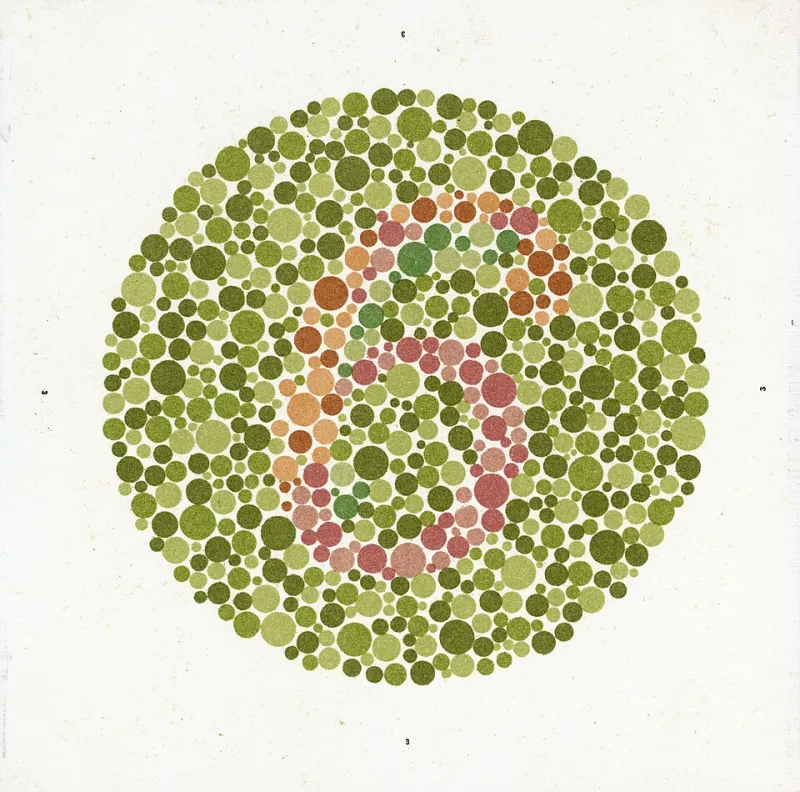
Photo: Shinobu Ishihara, Public domain, via Wikimedia Commons
Few vision tests carry as much quiet consequence as the color plate. A school nurse turns a page. An applicant for a police academy, aviation program, electrical apprenticeship, or military role sits at a machine. The results may be recorded simply as “pass” or “fail,” but the test is measuring something more specific: the ability to distinguish certain colors under controlled conditions.
Color vision testing is valuable, but it is also widely misunderstood. A failed screening is not a full diagnosis. A passed online quiz is not a guarantee. And a single plate test does not capture the full range of color perception, occupational demands, or safety risk. Opening Eye Care’s aim here is to explain what these tests actually reveal — and what to do when the answer is not what you hoped for.
What the Plates Are Actually Testing
Ishihara plates are the best-known color vision test. Each plate contains a circle of dots in varying sizes and colors. Within the pattern, dots of different hues form a number, a path, or another shape. People with typical color vision tend to see one figure; people with certain inherited color vision deficiencies may see a different figure or nothing at all.
The plates are examples of pseudoisochromatic testing. They are designed to separate colors that are easily confused by people with red-green color vision deficiency. They are quick, portable, and well established. They are also limited. Most Ishihara plates are not designed to grade severity precisely, and they are not a comprehensive test of all color vision.
Why the Test Is Common — and Why It Is Not Complete
Color vision matters in daily life and in many jobs. Traffic signals, wiring codes, medication labels, aviation instruments, and safety markings can all depend on color discrimination. A test that can identify people who may confuse certain colors is therefore useful.
But a plate test is a screening instrument. It does not by itself determine whether someone can perform a specific job safely. It does not measure every type of color deficiency. It does not assess acquired color vision loss from eye disease. And it does not account for lighting, fatigue, medication effects, or the visual demands of a particular task.
Red-Green, Blue-Yellow, and Acquired Changes
Color vision deficiencies are often grouped into red-green and blue-yellow types. Inherited red-green deficiency is the most common form and is far more frequent in males than females because of its genetic pattern. It can range from mild to significant. Blue-yellow deficiency is less common and can be inherited or acquired.
Acquired color vision changes are a different matter. They can occur with optic nerve disease, retinal disease, cataracts, medication toxicity, or neurological conditions. A sudden change in color perception, especially in one eye, warrants prompt medical evaluation. So does a change accompanied by vision loss, pain, or other neurological symptoms.
This distinction matters because a person who has always seen colors a certain way may have a stable inherited pattern. A person who notices a new difference may have a condition that needs diagnosis and treatment.
Online Color Tests: Convenience With a Calibration Problem
Online color vision tests are easy to find and tempting to use. They are also unreliable for formal decision-making. Monitor color profiles, screen brightness, ambient lighting, viewing distance, and compressed image quality can all change how plates appear. A person may pass on one screen and fail on another without any change in their eyes.
That does not make online tests useless as casual awareness tools. It does make them inappropriate for job applications, school placements, or self-diagnosis. If a color vision test matters for a license, apprenticeship, or employment requirement, it should be administered under standardized conditions by a qualified professional or an occupational health service.
Careers and Safety-Critical Work
Color vision requirements vary widely by occupation and by employer. Aviation, maritime work, rail operations, police and fire service, electrical trades, military roles, and some manufacturing positions may have specific standards. Some allow alternate tests or clinical evaluation; others have strict limits. A police department in one state may handle color vision differently from a department elsewhere. The Federal Aviation Administration, for example, has its own processes for evaluating color vision in pilots, and those processes are not identical to a simple school screening.
Because requirements are role-specific, broad claims are risky. The relevant question is not “Does this person have perfect color vision?” but “Can this person perform the essential tasks of this role safely and reliably, and what does the applicable standard require?”
If You Fail a Screening
A failed screening is not the end of the conversation. First, confirm that the test was administered correctly and under appropriate lighting. If the result matters for work or school, ask for a formal evaluation by an optometrist or ophthalmologist who can perform additional tests. These may include a D-15 panel, a Farnsworth-Munsell test, an anomaloscope, or a lantern test, depending on the question being asked.
Bring any prior test results and a description of your symptoms. If the color vision change is new, tell the clinician. Acquired color vision loss can be a sign of an eye or nervous system condition, and it should not be dismissed as a routine screening failure.
Accommodations and Realistic Planning
Some people with color vision deficiency develop effective workarounds: labeling cables, using task lighting, relying on redundant cues, or using apps that identify colors. These strategies can be helpful in everyday life. They may or may not satisfy occupational standards, especially in safety-critical roles. It is better to investigate requirements early than to discover a limitation after investing in training.
Formal accommodations are not available for every role, and no article can promise a particular outcome. A clinician can document your color vision status, but the employer or licensing body decides what it will accept.
The Opening Eye Care View
Color plate tests are useful, efficient, and worth taking seriously. They are also narrow. A pass does not prove perfect color vision, and a fail does not define a person’s future. The sensible path is formal testing when the stakes are high, prompt care when color vision changes suddenly, and realistic planning when a career depends on color discrimination. Clear vision, better living — and a clear understanding of what the test actually says.