Nearsightedness Is Getting Worse in American Children — Here Is What the Evidence Says Parents Should Do
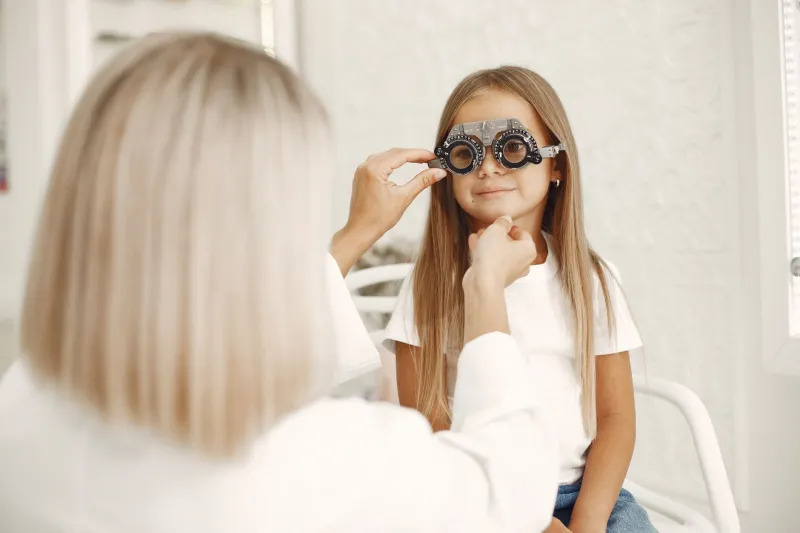
A generation ago, a child who needed glasses was the exception in a classroom. Today, myopia — the clinical term for nearsightedness — has become so common among American school-age children that it barely registers as a concern until the prescription climbs high enough to cause worry. It should register much earlier. Myopia is not simply an inconvenience correctable with glasses. At higher levels, it substantially increases the lifetime risk of serious conditions including retinal detachment, glaucoma, and macular degeneration. Understanding why it develops — and what can meaningfully slow its progression — is one of the most important things a parent can do for a child's long-term visual health.
How Widespread Is the Problem?
Epidemiological data paints a striking picture. Studies estimate that approximately 42 percent of Americans between the ages of 12 and 54 are myopic — a figure that has roughly doubled since the early 1970s. Among children specifically, the trajectory continues upward, and researchers project that nearly half of the world's population could be myopic by 2050 if current trends continue.
The shift is not primarily genetic. Human DNA does not change meaningfully over a few decades. What has changed is the environment in which children's eyes are developing — and that distinction matters enormously, because environmental factors are, to a meaningful degree, modifiable.
What Is Actually Driving the Rise?
Myopia develops when the eyeball grows slightly too long from front to back, causing light to focus in front of the retina rather than directly on it. During childhood, the eye is still growing, and certain environmental conditions appear to accelerate that elongation beyond what normal vision development requires.
Reduced outdoor time has emerged as one of the most robustly supported contributors. Numerous studies across different populations have found that children who spend more time outdoors develop myopia at lower rates and progress more slowly when they do develop it. The mechanism is not fully resolved, but the leading hypothesis centers on light intensity. Outdoor light — even on an overcast day — is dramatically brighter than indoor lighting, and high-intensity light appears to stimulate the release of dopamine in the retina, which in turn inhibits axial elongation of the eye.
Near work and screen time have long been suspected contributors, and the association is real — though the relationship is more nuanced than the simple narrative of "screens cause myopia." The concern is not the screen itself but the sustained focus at close distances and, more importantly, the time spent indoors that screen use tends to displace. Children who spend hours on tablets and smartphones are not spending those hours outside.
Genetic predisposition remains relevant. A child with two myopic parents faces a significantly higher risk of developing myopia than a child with no family history. But genetics appear to function more as a susceptibility factor than a destiny — environmental conditions determine whether and how severely that susceptibility is expressed.
Evidence-Based Interventions: What Actually Works
The marketplace for myopia management has expanded rapidly, and not every product or approach being marketed to parents has equivalent scientific backing. The following represents the current state of evidence for interventions with genuine clinical support.
Increased Outdoor Time
This is the most accessible and least expensive intervention available, and the evidence base is among the strongest. Clinical trials — including large-scale studies conducted in Taiwan and China — have demonstrated that adding one to two hours of outdoor time per day can meaningfully reduce the onset of myopia in children who have not yet developed it and slow progression in those who have. The threshold appears to be roughly two hours daily, and the key variable is the outdoor light exposure itself, not physical activity per se. A child reading outdoors may receive comparable benefit to one playing a sport outside.
For American families navigating packed after-school schedules, this recommendation may require deliberate restructuring of daily routines, but it carries no cost and no clinical risk.
Atropine Eye Drops
Low-dose atropine — a medication administered as a nightly eye drop — has demonstrated significant efficacy in slowing myopia progression in multiple randomized controlled trials. Concentrations of 0.01 percent to 0.05 percent have shown meaningful reductions in axial elongation with a more favorable side effect profile than higher concentrations used historically. Side effects at low doses are generally minimal, though some children experience mild light sensitivity.
Atropine is not currently FDA-approved specifically for myopia control in the United States, which means it is prescribed off-label. This is a common and legally permissible practice in American medicine, but it means parents should have a thorough conversation with their child's ophthalmologist or optometrist about the evidence, the dosing rationale, and appropriate monitoring.
Orthokeratology
Orthokeratology — commonly called ortho-k — involves wearing specially designed rigid contact lenses overnight. These lenses temporarily reshape the corneal surface, allowing the child to see clearly during the day without glasses or contacts. Beyond the convenience factor, ortho-k has been shown in multiple studies to slow the rate of axial elongation compared to standard single-vision correction. The effect is thought to relate to how the reshaped cornea alters peripheral retinal defocus, reducing the signal that drives eye elongation.
Ortho-k requires a motivated child, consistent compliance with lens care protocols, and regular follow-up with a practitioner experienced in fitting these lenses. It is not appropriate for every child, but for families open to contact lens wear, it represents a well-studied option.
Multifocal and Defocus-Designed Contact Lenses
Several soft contact lens designs specifically engineered for myopia control have reached the US market in recent years. MiSight 1 day, manufactured by CooperVision, was the first FDA-approved contact lens for myopia control in children, supported by a three-year clinical trial showing a meaningful reduction in both prescription progression and axial elongation. Other designs using similar optical principles are available or in development.
These lenses are worn during waking hours like standard contact lenses and are particularly suitable for children who are not comfortable with the overnight wear required by ortho-k.
What the Evidence Does Not Support
Parents should approach certain claims with appropriate skepticism. Vision therapy exercises designed to reduce myopia, specialized nutritional supplements marketed specifically for nearsightedness control, and various screen-filtering technologies have not demonstrated meaningful efficacy in slowing myopia progression in peer-reviewed clinical trials. This does not mean nutrition is irrelevant to eye health broadly — there is reasonable evidence supporting certain nutrients for conditions like age-related macular degeneration — but the specific claim that dietary supplements slow myopia progression in children lacks adequate clinical support.
When to Start the Conversation With an Eye Care Provider
Myopia control is most effective when initiated early in the progression curve. A child whose prescription is climbing rapidly — typically defined as worsening by 0.75 diopters or more per year — is a candidate for a dedicated myopia management discussion. Even children with mild myopia who have a strong family history and significant near-work demands may benefit from proactive intervention before progression accelerates.
Annual comprehensive eye examinations are the foundation of monitoring. If your child's optometrist or ophthalmologist has not raised the topic of myopia management, it is entirely appropriate to ask directly: is my child's prescription progressing, and is there a clinical case for intervention?
The trajectory of a child's myopia is not fixed. With the right combination of environmental adjustments and, where appropriate, clinical intervention, meaningful slowing of progression is achievable — and the long-term visual health implications of that slowing are substantial.